


A Targeted Technique That Helps You Move Easier and with More Control
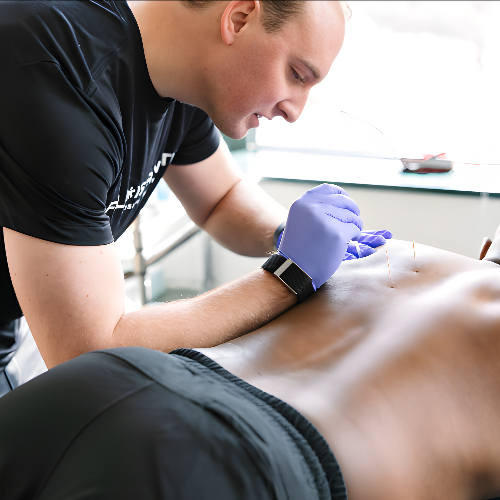
Dry needling can help when tight or overworked muscles hold you back. Many people describe a deep, stubborn tension that shows up when they lift, run, twist, or try to stay steady during a task. That tension can make you hesitate, change your form, or stop short, which slows progress. During dry needling in Alexandria, VA, Springfield, VA and Arlington, VA at Full Strength, your therapist uses a thin, sterile needle to target those tight spots and help them relax. After treatment, many people notice easier movement, less pull or tightness, and more confidence to move and train the way they want.
Our team uses dry needling as part of a broader plan designed around your goals. You learn what your body is doing, why tension builds, and how to improve control so progress continues long after symptoms settle.
How Dry Needling Supports Your Movement
Dry needling uses thin, sterile needles to reach tight or sensitive spots in your muscles. This can help those areas relax, improve how your muscles and nerves work together, and make movement feel smoother. When the right muscles ease up and then switch on at the right time, your body can move through lifts, strides, and daily tasks with less gripping, stiffness, and strain.
Dry needling works best as part of a complete plan. At Full Strength, your therapist may pair it with hands-on physical therapy, targeted strengthening, mobility drills, and coaching on form and training load. We explain how each treatment fits together so every session, set, and repetition has a clear purpose in your progress.
Common Reasons People Seek Dry Needling at Full Strength
Tension that disrupts lifting patterns
Irritation in high-demand areas
Stiff movement
Running-related tightness
Overuse irritation
Pain that keeps coming back
Injury Recovery
Supporting Relief While You Rebuild
Dry needling can help calm irritated tissues so you can move with more comfort as you start rebuilding after an injury or surgery. When tight muscles relax, it becomes easier to move the way your therapist is teaching you, and strength work often feels smoother and more effective.
- Targeted dry needling application: releasing tension in specific muscles
- Guided movement training: practicing movements that feel more natural and less guarded
- Technique coaching: fine-tuning how you squat, reach, push, or step so your body feels better under load
- Return-to-activity planning: creating a step-by-step path back to normal daily tasks, work, lifting, or sport
- Education that sticks: explaining what likely caused the irritation and how to lower the chance of it coming back
Health and Performance
Supporting Recovery and Readiness for Training
Dry needling can play an important role in health and performance when the goal is recovery and readiness. After periods of increased training volume or intensity, muscles can stay tight, sore, or limited in how they move. That lingering tension can make training feel harder than it should and slow recovery between sessions.
- Reducing muscle tightness and soreness: easing post training stiffness after hard sessions or heavy volume
- Improving range of motion: helping joints and muscles move more freely
- Supporting workout recovery: allowing your body to feel ready for the next session sooner
- Improving movement quality: making lifts, strides, and daily movement feel smoother
- Preparing the body for training: creating better conditions for strength, mobility, and stability work
- Long-term consistency support: helping you stay on track through demanding training cycles
Why People Trust Full Strength

Your goals guide the plan. We listen first and design a strategy that fits how you move and train.

Your progress stays clear. You learn why tension builds and how to change the pattern.
Your movement is respected. We work with your training style, not against it.
Your body learns new possibilities. Each step helps you move with control and confidence.
Your community supports you. You improve alongside people who value movement, effort, and progress.
-
“Ten-Star Experience”
From scheduling to treatment, the experience was seamless. Victoria listened closely, pushed me to improve each week, and delivered top-level care throughout my recovery.
–
Jonathan D.
-
“Supported Before and After Surgery”
Michelle Goto has been awesome. She prepared me for surgery, and has helped me recover super well afterwards!
–
Ryan N.
-
“Enjoyable and Effective PT”
Daniel has been great to work with and really listened and let me push myself in a safe way. Made PT enjoyable but hard!
–
Paul B.
-
“Attentive Care in a Friendly Atmosphere”
Ray was incredibly attentive, creating a solid treatment plan that helped me recover quickly. I always felt supported, and the entire team is friendly and welcoming. The upbeat, fun atmosphere—from the front desk to all the trainers—makes every visit enjoyable.
–
Gia N.
500+ five-star
google reviews
17+ years serving arlington,
alexandria, & springfield
Frequently Asked Questions
Does dry needling hurt?
Is dry needling safe?
How does dry needling fit into my plan?

a simple plan to get you moving forward
Your next steps
Schedule your assessment
An expert PT will listen to you and assess your problem.
Get your personalized plan
Know exactly what to focus on, and what to do next.
Keep Progressing with Expert Guidance
Improve how you move so your results last.
related blogs
-

Improve Your Golf Performance Through Smarter Body Mechanics
Improve golf performance with smarter body mechanics, better golf swing basics, and expert movement assessment from physical therapy.
-

5 Expert-Approved Power Training Exercises for Longevity
Power training helps adults over 40 build speed, strength, and resilience to prevent falls and support longevity and lifelong independence.