Your bone mineral density will decrease with age. It’s just a fact. But that doesn’t mean you will get osteoporosis. Osteoporosis occurs when bone mineral density decreases below a specific level. It is also more common in women than men, especially after menopause.
As bone mineral density decreases, the risk of fractures increases, especially from falls. Falls are actually the leading cause of accidental death for people over the age of 65. Osteoporosis makes you more likely to have a bone fracture as a result of a fall.
The most commonly fractured bones as you age are the hip, forearm, and spine. Most people don’t die directly from the fall, but because of the decrease in ability to move that happens when your body is trying to heal from the fracture and because many people never regain the strength and ability to move that they had before the fall.
Reduce your risk
So how can you reduce your risk of osteoporosis? Fortunately you can reduce your risk of osteoporosis and your risk of falling with exercise. Bone mineral density is stimulated by apply loads to your bones. The bones then rebuild over time in response to the stress.
The earlier you start (think in your 40’s and 50’s) the better off you are. But starting when your older is still not too late.
What exercises should you do? 2 types provide the most benefit: Resistance training and jumping. That’s because to stimulate bone growth the load needs to be heavy or sudden. Here are 3 exercises that will help.
Squats
Squats are a great way to build strength in the muscles and bones of your hips, thighs, and spine. Proper technique is important.
- Start by pushing your butt back as you lower down.
- Keep your weight over the center of your foot and your butt behind your feet. If your butt drifts over your feet, you won’t get the work at your hips and it will put more stress on your knees. Your knees should not collapse in either.
- As you can see in the video, your knees should stay lined up with the center of your foot.
- You should feel this working mainly in your butt and thighs.
- Start with 2 sets of 10 reps and hold for 5 seconds at the bottom. Do these 3 days a week. Try to work up to 3 sets of 10 reps.
Deadlift
Deadlifts are especially good at developing strength in the bones and muscles of your spine and hips. A couple key points:
- It’s really important to keep a slight arch in your low back throughout the movement. You should not bend forward at your back at all. You’ll see in the video the bend is happening at the hips and knees
- Start with the weight on a chair or gym bench instead of the floor. Even starting with no weight and just practicing the movement can be helpful.
- Don’t worry about lowering the weight all the way to the floor. Start just trying to get your hands to knee level. This will help you maintain good form
- Start with 3 sets of 10 to get used to performing the movement correctly. Don’t worry about trying to make the weight heavy when you first start.
Standing Press
Standing presses help by applying a load to your wrist as well as through your spine and hips. If you can’t lift overhead, you can do a pushup instead to get the load through your wrist and forearm.
Start with a load that you can do for 3 sets of 10. Do these 3 days a week.
It’s really important to start with minimal or no weight on both these exercises first to get used to doing them correctly. This will help you prevent you from injury when you take the next step.
Intensity Matters
The bone density gains really occur with heavy loading. You do this by doing 2-3 easy sets at light weight to warm up. Then do 4 to 5 sets of each exercise for 5 reps on each set. How much weight is light and how much is heavy? Use this table to guide you based on how difficult each set feels:
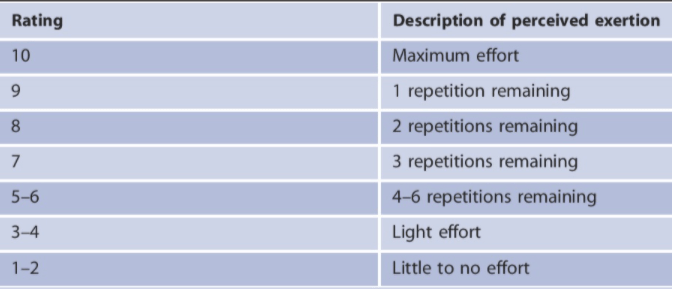
The number of repetitions remaining means that’s how many more repetitions you could have done at that weight. If you’re using the right weight, the easy sets should be a rating of 3 to 4. The heavy sets should be a rating of 8 or 9.
It’s really important to get the load right. In one study, women with osteoporosis who did 5 sets of 5 reps of heavy resistance exercise for 8 months improved their bone mineral density by an average of 3% vs a loss of 1% in the group who did strength exercises at a moderate resistance.
In addition, the leg strength of the heavy resistance group increased by 37% and back strength increased by 36% compared to 5% and 11% in the moderate resistance group.
A measure of fall risk called the functional reach test improved by 5.5% in the heavy resistance group compared to 0.1% in the moderate resistance group.
To summarize, heavy strength training can improve your bone mineral density, increase your strength, and reduce your risk of falls.
If this seems really overwhelming or you’ve tried it and something doesn’t feel right, we can help you! At Solutions Physical Therapy & Sports Medicine, we’re experts at strength training and can help you use it to prevent and reverse bone loss.
Call us at 703-299-3111, or click here to request an appointment.
A member of our team will schedule you an appointment with one of our expert physical therapists.
Why is it important for you to improve your bone strength?
- Low bone mineral density puts you at greater risk of missing out on life because of broken bones
- After 65, broken bones from falls are the leading cause of accidental death
Starting a program to increase your bone strength can:
- increase your bone strength so your bones are less likely to break
- help you prevent falling
- increase your strength and ability to live the active life you want
The exercises above are a great way to get started. They can help you get moving and living stronger.
But if you want an expert to listen to you and guide you to success, a Solutions Physical Therapy & Sports Medicine physical therapist in Alexandria, Springfield, or Arlington, VA will create a plan specifically for you.
You’ll feel confident that you have the knowledge and capacity to do all the things you want.
Call us at 703-299-3111, or click here to schedule your appointment and get started.
Working to keep you living your best life,
The Solutions Physical Therapy & Sports Medicine Team