You’ve probably been told that you need to do aerobic exercise to decrease your risk of a heart attack. Aerobic exercise improves your cardiorespiratory fitness (CRF). But did you know that CRF is now considered to be the most powerful predictor of likelihood of dying from any cause?
In 2016, the American Heart Association issued a statement recognizing CRF as a potentially stronger predictor of mortality than established risk factors such as smoking, hypertension, high cholesterol, and type 2 diabetes. The best way to measure your CRF is by measuring your VO2 max.
What is VO2 Max?
VO2 Max is the maximum amount of oxygen that your lungs can deliver through your bloodstream to your muscles when you exercise. When you exercise, your lungs move oxygen into your blood. Then your heart pumps that blood through your blood vessels. Finally, your blood vessels transport the oxygen into your muscles. VO2 max measures how well this whole system works.
Your VO2 max is best measured during a formal exercise test but can be estimated via less formal “field tests” as well. The results of the test are often reported in ml of O2 per kg of body weight per min and sometimes as metabolic equivalent units (MET’s).
Consequences of Low VO2 Max
Low VO2 max significantly increases your risk of dying of all causes. It can also increase your risk of cardiovascular disease as well type 2 diabetes, stroke, dementia, Alzheimer’s disease and some cancers.
The images below are from a study of 122,007 patients (average age was 53 years old) by Mandsager, et al published in 2018. It shows the difference in survival rates among people with different levels of VO2 max performance.
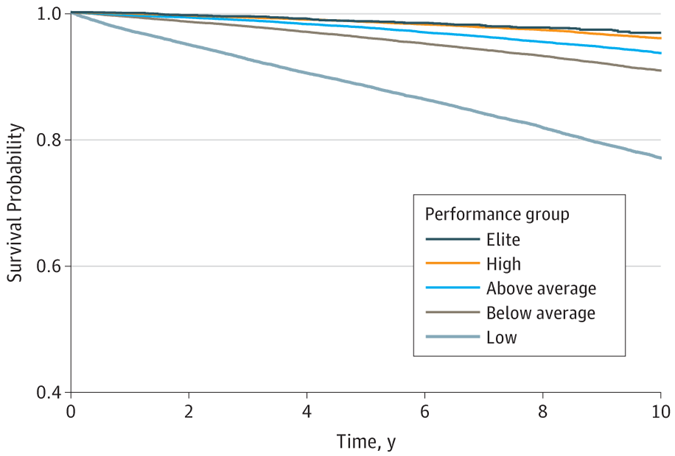
Classification (percentile range) is as follows: low (<25th percentile), below average (25th-49th percentile), above average (50th-74th percentile), high (75th-97.6th percentile), and elite (≥97.7th percentile).
So if you were in the lowest 25% of performers on VO2 max testing, there was a greater than 20% chance that you would be dead in 10 years.
How You Can Improve Your VO2 Max
There is more than one way you can do this.
Strategy 1
Aerobic training is primarily prescribed based on % of maximum heart rate (HR max). Some research shows that training for 20 to 30 min at 60% to 70% of HR max 3 to 5 days a week can increase VO2 max if you’re untrained. So if you’re already in the lowest 25 percent, this is the place to start. You want to just get used to moving again.
The research does show that high intensity interval training (HIIT) works best if you’re already relatively healthy, overweight/obese or athletic.
Strategy 2
- Short work interval (≤30 seconds of work per interval at 85% to 95% of HR max)
- Low-volume (≤5 min of total work/session)
- Example: 30 seconds of work, followed by 30 seconds of rest for a total of 10 rounds.
This strategy allows you to be time-efficient and it’s highly effective for improving VO2 max, especially for the general population. You can see VO2 max improvements with as little as 4 weeks of training.
Strategy 3
- Longer interval (≥2 min of work per interval at 85 to 90% of HR max)
- Higher volume (≥15 min of work/session)
- Example: 3 min of work followed by 3 minutes of rest for a total of 5 rounds
This strategy requires more time, but you can see greater improvements in VO2 max.
With Strategies 2 and 3, exercising 2 times a week is enough for you to see good improvements. Doing more than 3 times a week is probably going to take time away from other things you could be training without much gain in VO2 max.
Again, if you’re not used to aerobic exercise, building a baseline of aerobic fitness in the 60% to 70% is a good place to start. You’ll see some initial gains in VO2 max and get your body used to exercise.
If you’ve built a good base in the 60% to 70% HR zone, then HIIT training can help get you the rest of the way to your goals.
Are there obstacles preventing you from getting active again? Are joint pain or muscle weakness making you apprehensive about getting started? We can help you!
At Solutions Physical Therapy & Sports Medicine in Alexandria and Springfield, VA, our physical therapists are experts at helping people get back to an active life.
Call us at 703-299-3111, or click here to request an appointment.
A member of our team will schedule you an appointment with one of our expert physical therapists.
What happens if you don’t have a plan to improve your VO2 max?
- You feel get tired and out of breath when you’re going up and down the stairs.
- You’re more likely to get injured when you play sports.
- You increase your risk for other diseases.
But with a plan to improve your VO2 max you can live the confident and active life you want.
If you want an expert to listen to your unique problems and guide you to success, a Solutions Physical Therapy & Sports Medicine physical therapist in Alexandria or Springfield, VA will create a plan specifically for you.
You’ll feel confident that you have the knowledge and ability to stay active and do all the things you want.
Call us at 703-299-3111, or click here to schedule your appointment and get started.
Working to keep you living your best life,
The Solutions Physical Therapy & Sports Medicine Team