


You’ve been running for years. Maybe you’ve dealt with the same nagging knee pain that flares up every few miles. Maybe your times have plateaued no matter how many miles you log.
A running analysis is one of the most direct ways to get real answers.
And yet most runners never do one.
Instead, they stretch, ice, and push through. Then wonder why nothing changes.
Here is exactly what happens when you come in for a running analysis at Full Strength Physical Therapy.
What a Running Analysis Reveals That Most Runners Never Notice
The first part of your assessment happens on the treadmill.
You’ll lace up and run at your normal pace. Your physical therapist will video your gait from multiple angles as you run. This is often where runners have their first real look at how they actually move.

Most runners have never seen themselves run. What you feel and what is actually happening are often two very different things.
The video gives your PT a clear window into your mechanics. They will identify specific gait deviations. Those are movement patterns that are either costing you energy or setting you up for injury.
Common findings include overstriding, where your foot lands too far in front of your center of mass. Others include excessive vertical bounce, a crossover foot strike pattern, or a forward trunk lean that shifts load onto the wrong structures.
These deviations do not feel obvious mid-run. However, they show up clearly on video.
Research published in the Journal of Orthopaedic and Sports Physical Therapy shows that targeted gait retraining significantly reduces injury-related loading patterns in runners. Identifying those patterns is the first step toward changing them.
Once your PT identifies the deviations in your running analysis, everything that follows is built around correcting them.
The Gaps Your Running Analysis Will Uncover
Watching you run tells part of the story. But how you move on the treadmill is directly shaped by what your body can and cannot do off of it.
That is why your running analysis includes a full musculoskeletal assessment. Your PT will evaluate three key areas:
- Flexibility and mobility. Tight hips, limited ankle dorsiflexion, or restricted thoracic rotation all show up in your stride. If your hips cannot extend fully, your body will compensate somewhere else. That compensation often looks like an arched lower back or a forward trunk lean under fatigue.
- Strength. Weakness in the glutes, hip abductors, or core is one of the most common contributors to inefficient running mechanics. Weak glutes mean your knee absorbs more lateral force than it should on every single step.
- Stability. Your body needs to control movement, not just produce it. Single-leg stability deficits often translate to a visible collapse at the knee when fatigue sets in during a run.

These three areas work together. Your PT connects the dots between what the video revealed and what the physical assessment confirms. That connection is what makes a running analysis different from a basic video review. It is a complete picture of how you move and why.
If you have been dealing with recurring pain that keeps coming back, read our post on 5 Signs Your Running Form Is Setting You Up for Injury for more on how mechanics drive injury cycles.
What You Take Home After Your Running Analysis
This is where your running analysis becomes something you can act on.
After reviewing your gait video and completing the musculoskeletal assessment, your PT will walk you through their findings. You will know exactly which gait deviations were identified, what physical gaps are contributing to them, and what needs to change.
Then comes the plan.
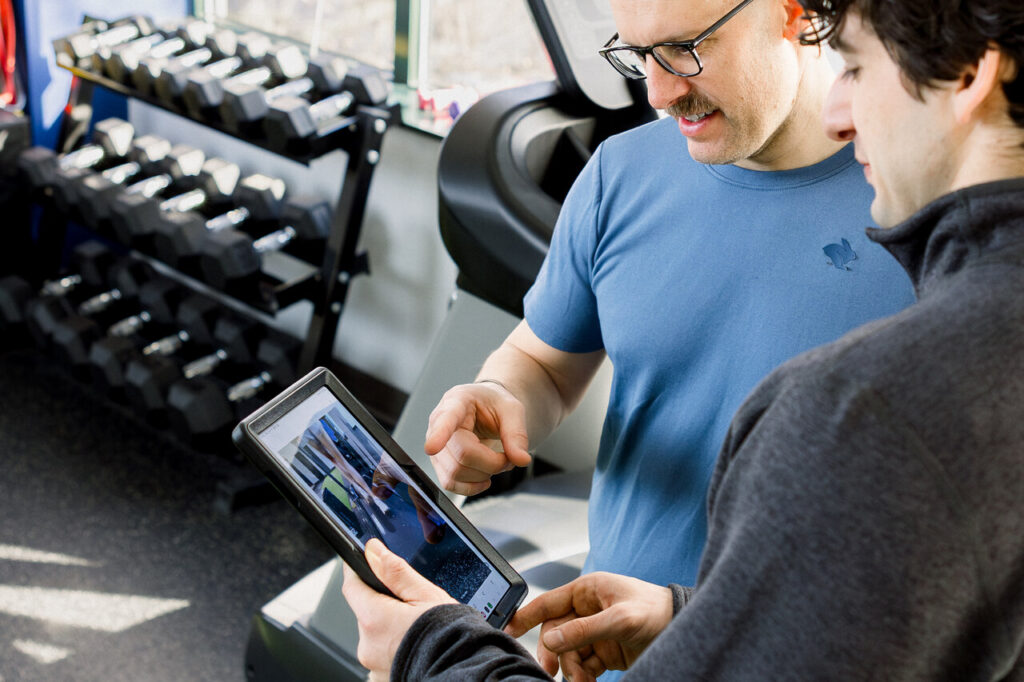
If you have a strength deficit, you will receive specific exercises to address it. These are not generic gym movements. They are chosen based on your individual findings and how those gaps are showing up in your running mechanics.
If flexibility or mobility is the issue, your PT will prescribe targeted stretching and mobility drills. In some cases, manual therapy is performed during the session to address restrictions that exercises alone will not resolve quickly.
You leave with a structured program to continue on your own. Most runners make meaningful progress by following this plan consistently between runs.
Some runners have minor deviations that are straightforward to correct with a home program. Others have more complex patterns that benefit from ongoing performance therapy sessions. Your PT will be direct with you about which path makes sense based on what they found.
Runners over 40 often discover that their recovery and correction needs are more layered. Our post on Why Runners Over 40 Get Injured Differently (And What to Do About It) breaks down why age changes the equation and what to expect.
Is a Running Analysis Worth It for Everyday Runners?
Yes. A running analysis is valuable at any level. Whether you are training for your first 5K or trying to take time off a half marathon, understanding how you move is fundamental to doing it better and doing it longer (and without injury!).
Two of the most common reasons runners come in for an assessment:
- You want to resolve pain that keeps returning,
- You want to get faster.
A running analysis directly addresses both of these concerns.

For injury recovery, the combination of video and physical assessment removes the guesswork from treatment. Your PT is not working from a general protocol. They are working from your specific data.
For performance, gait efficiency matters more than most runners realize. Small mechanical deviations waste energy with every step. Over the course of a 10K or a marathon, those inefficiencies add up. Correcting your mechanics means your body works smarter and your runs are more enjoyable.
The PT leading your assessment is an expert in running. They bring clinical knowledge and a deep understanding of biomechanics together to give you a plan that is specific to you. That is a different experience than a shoe fitting at a running store or a YouTube form tutorial.
Book a running analysis at Full Strength Physical Therapy to give you a clear look at how you move, what is holding you back, and exactly what to do about it.






Leave a Reply