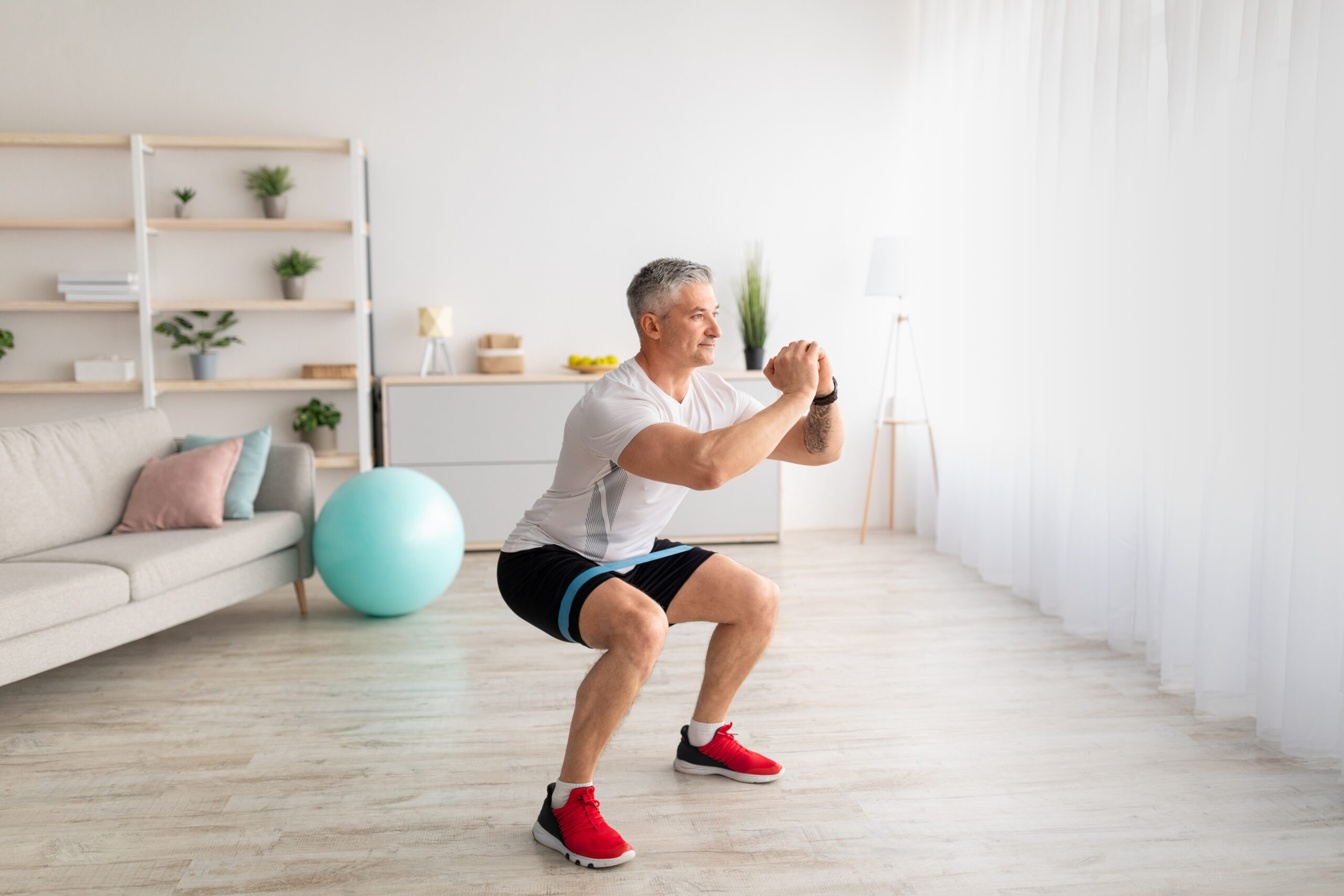
Have you heard that squatting is bad for your knees? Has someone told you to never do a squat again?
Unfortunately this is a common misconception and it isn’t supported by research. There are times after injury that you may need to make modifications while injured tissues heal.
However the goal should be to get you back to being able to squat again. Here’s why you should squat and how.
You want to have as many movement options as you can to complete everything in your life that you need to do. Here are a couple examples in the video below.
Each video shows someone doing a task when they have the ability to squat, and then again when they don’t.
(The guy in the video looks a little unkempt, but we’ll cut him some slack since he just wrapped up his morning workout and he’s getting his kids ready for school.)
Which of these looks like the least amount of work? Now let’s say you’ve injured your low back playing soccer in the parents vs kids pickup game.
The person who can’t squat can only bend over to lift. This person is going to have an angry spouse because he/she isn’t able to help around the house.
The person who can squat can still lift things and help around the house with minimal stress on his low back and his relationship.
Which of these looks like it is easier to do? The person who can squat easily stands up off the toilet without needing to use his hands.
The person who can’t squat has to lean forward, use his hands, and is at a much higher risk of falling.
These are just a couple examples of why you should be able to squat. But if you can’t do it, how do you get there?
Here’s the best exercise you can do to teach yourself how to squat if you can’t do it right now.
Doorway/Squat Rack Assisted Squat Phase 1
We’re using a squat rack here, but if you don’t have one, a doorway works just as well.
Start with your feet shoulder width apart (can be wider if you have long legs relative to your torso.)
Place your hands on the sides of the doorway or squat rack. Hold onto the doorway or squat rack as you send your butt down and back. This is going to keep you from falling over backward as you get lower.
Here’s the key: make your knees come forward over your feet. Spread your knees apart so there is room for your pelvis to get level with your thighs. Otherwise you’ll just be jamming your thighs into your hips.
Try to get low enough that your thighs are parallel with the floor.
Once your at the bottom, make sure your knees are right under your elbows. If they’re not, then you haven’t brought your knees far enough forward over your feet.
Now slowly breathe in and out. Think 4 second inhale and 4 second exhale. You are trying to teach your body how to be in this position.
You may find that the front of your thighs and your shins are working really hard. That is 100% ok.
Once you’ve breathed in and out 1 time, stand back up to the top.
Do anywhere from 5 to 10 reps, depending on how difficult it was for you.
Doorway/Squat Rack Assisted Squat Phase 2
This is done just like Phase 1, except now you decrease how much pressure you applying into the doorway. Still use the doorway on the way down, but try to take the pressure off as you stand back up.
If you work on this daily, you’ll be able to progress to doing a squat without the doorway’s help. At that point, congratulations, let’s add some weight!
If you’re trying this exercise but it’s causing pain (not muscle fatigue, but true pain), there may be some underlying issues with your joints or muscles that need to be addressed before you can do this successfully.
If you’ve tried this and you’re struggling or it hurts, we can help you!
At Solutions Physical Therapy & Sports Medicine in Alexandria and Springfield, VA, we’re experts at helping people squat and move fluidly and correctly.
Call us at 703-299-3111, or click here to request an appointment.
A member of our team will schedule you an appointment with one of our expert physical therapists.
What happens if you don’t have a plan to improve your squat?
- You struggle to get out of a chair.
- Your spouse gets irritated with you because your can’t do things around the house.
- You’re more likely to fall during daily life or sports, risking fractures and other injuries.
But with a plan to improve your squat you can live the confident and active life you want.
If you want an expert to listen to your unique problems and guide you to success, a Solutions Physical Therapy & Sports Medicine physical therapist in Alexandria or Springfield, VA will create a plan specifically for you.
You’ll feel confident that you have the knowledge and ability to stay active and do all the things you want.
Call us at 703-299-3111, or click here to schedule your appointment and get started.
Working to keep you living your best life,
The Solutions Physical Therapy & Sports Medicine Team