

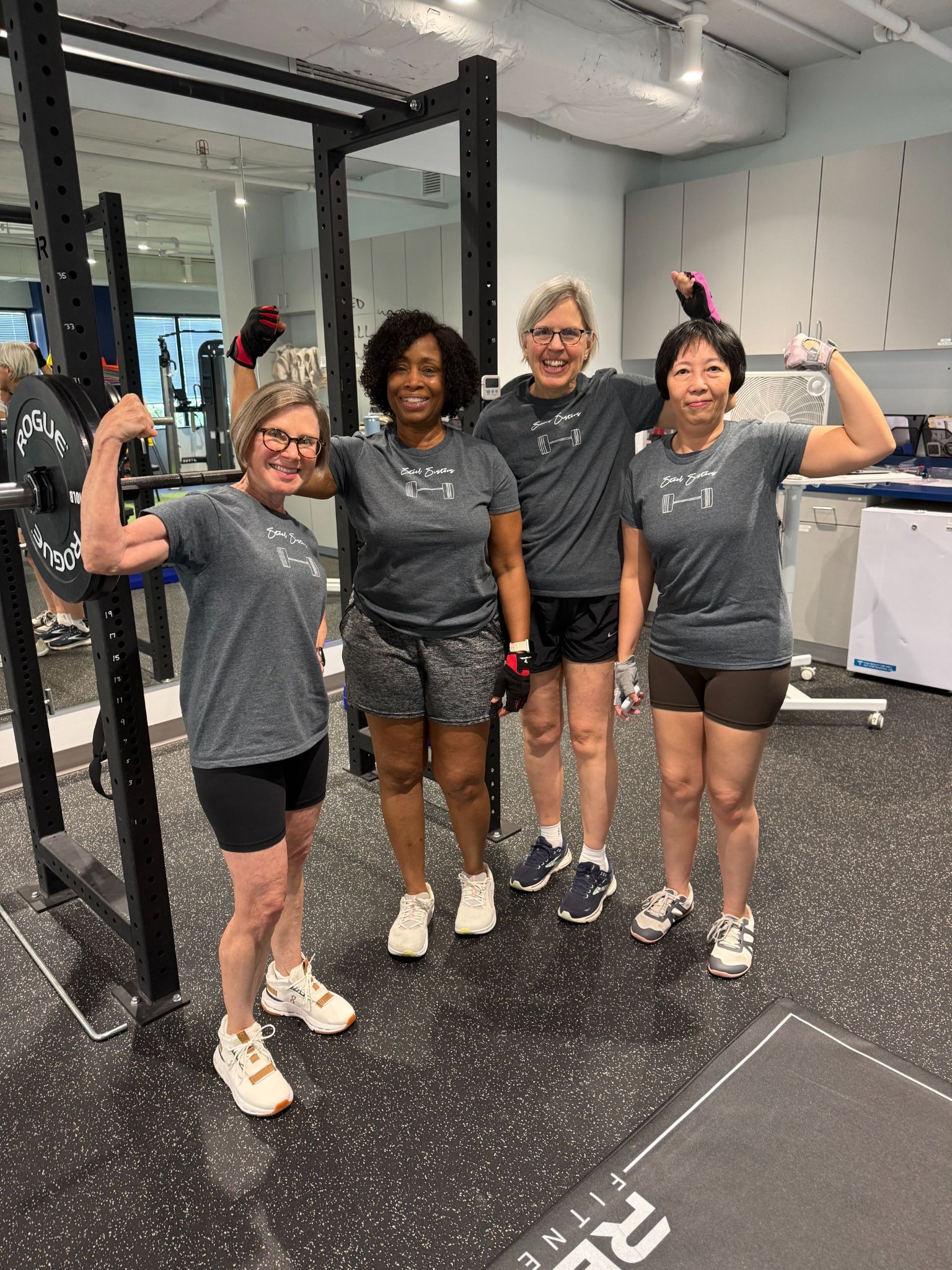
Most osteoporosis workout advice still tells you to play it safe: walk more, swim laps, and trade heavier weights for two-pound dumbbells. Research tells a different story. Trials on postmenopausal women show that heavy squats and controlled impact, introduced gradually and supervised by a professional, build meaningfully more bone density than gentle, low-load movement.
Picture the moment before you bend down to grab a grocery bag off the floor. Or maybe it’s the second you decide whether to empty the dishwasher yourself or ask someone else to do it. You hesitate. Maybe a doctor handed you a DEXA scan result and told you to “be careful.” That advice comes from a good place, but it often gets translated into something far less helpful: you stop picking up anything heavy so your muscles and bones grow weaker day by day. Being “careful” actually increases your risk of a fall.
Bone loss speeds up after menopause. Some women lose 20 to 30 percent of their bone density within five years of their final period. Avoiding impact and heavier loads does not protect you from that decline; it accelerates it. What actually slows and even reverses bone loss is progressive loading paired with smart, spine-sparing movement patterns you can use every day, from getting out of bed to lifting a grandchild off the floor.
What an Osteoporosis Workout Actually Looks Like
An osteoporosis workout simply means any movement where your bones and muscles work against gravity or an external load. This could be stair climbing, squatting, and yes, jumping. It differs from swimming or cycling, which are wonderful for your heart but do very little to build bone because your body weight is supported by water or a seat.
The problem with “better safe than sorry” advice is that it does not actually help your bones get stronger. Bones respond to stress the same way muscles do: without enough load, they get weaker. Research on high-intensity resistance and impact training, including the landmark LIFTMOR trial published in the Journal of Bone and Mineral Research, found that postmenopausal women who lifted heavy (80 to 85 percent of their one-rep max) and added supervised impact work increased lumbar spine bone density by nearly 3 percent over eight months. Women in a low-intensity, unsupervised program actually lost bone density during the same period.
So the real question is not whether an osteoporosis workout is “safe.” Also worth asking: what happens if you skip it? Deconditioning from underloading leads to weaker glutes, a less stable core, and slower reaction time when you stumble, exactly the combination that turns a minor trip into a fracture.
The good news is you do not have to figure this out alone or guess at how heavy of weights to pick up or what exercises to do. Our Building Strong Bones guide breaks down how supervised progressive loading compares to walking-only programs, and it is the foundation every client in our Bone Health Training Program starts from.
Spine-Sparing Movement Protects Your Back Between Workouts
The exercises you practice with a physical therapist only protect you if the habits transfer to your kitchen, garden, and bedroom. Deep forward bending or twisting while holding something heavy is a common way people lower bone density. It happens most often on an ordinary Tuesday than from a single dramatic fall.
Three spine-sparing swaps make daily life significantly safer:
- Getting out of bed. Instead of sitting straight up and twisting toward the edge, roll onto your side first, then push up with your arms. This “log roll” keeps your spine in a neutral position and can quiet the stiffness many women notice first thing in the morning.
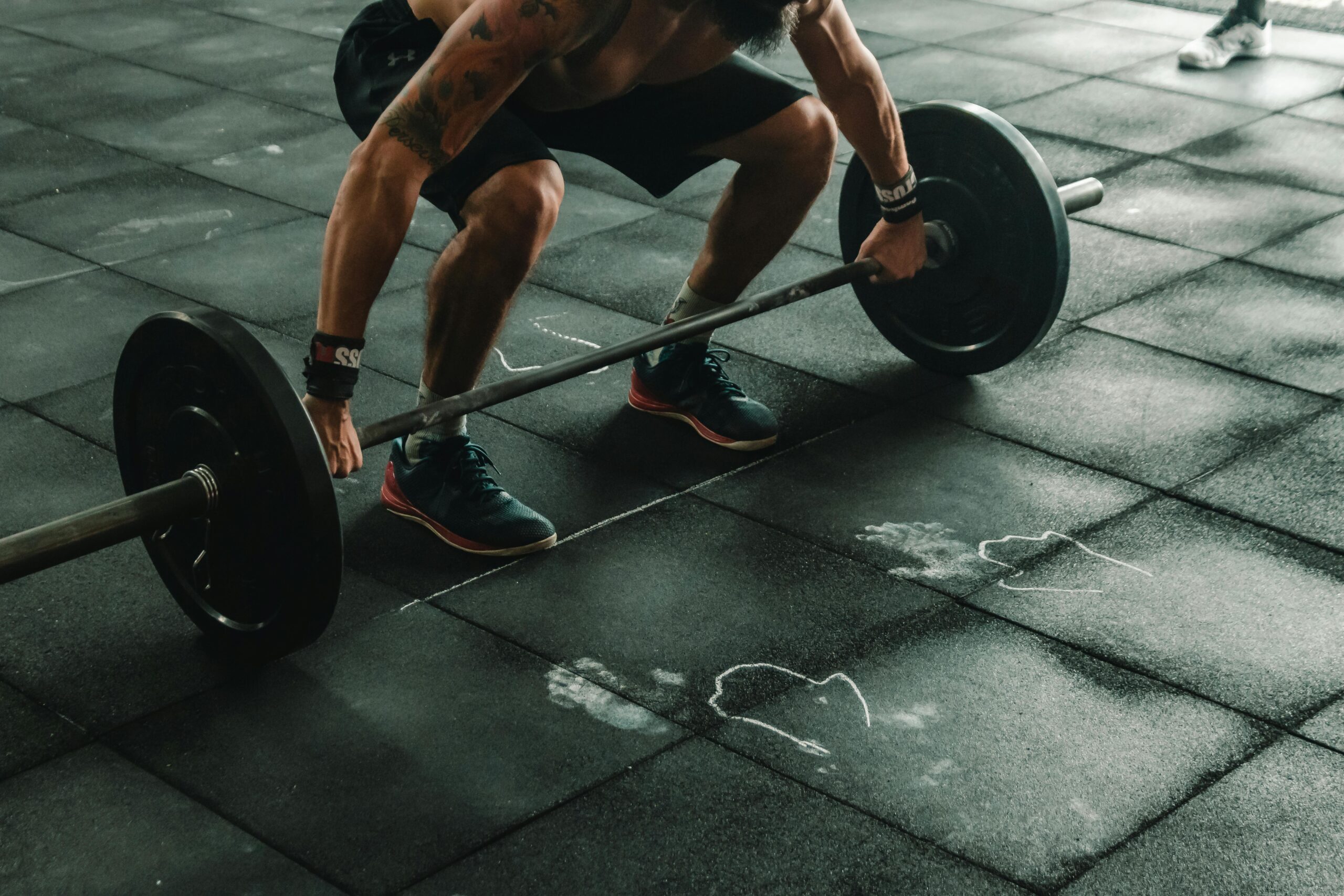
- Picking things up. Swap bending at the waist for a hip hinge, the same pattern used in a deadlift. Push your hips back, keep your spine long, and let your legs do the work when you lift groceries, a laundry basket, or a bag of mulch.
- Reaching low shelves or the floor. Use the strength of a squat to lower your body rather than rounding your back to reach down.
None of these movements are complicated, but they take repetition to become automatic. When you rehearse them in a supervised setting first (like in our Bone Health Training Program), they start to feel natural everywhere else: at the sink, in the garden, in the car. Consistent practice is what protects your spine over the decades ahead.
The One Exercise Every Osteoporosis Workout Needs
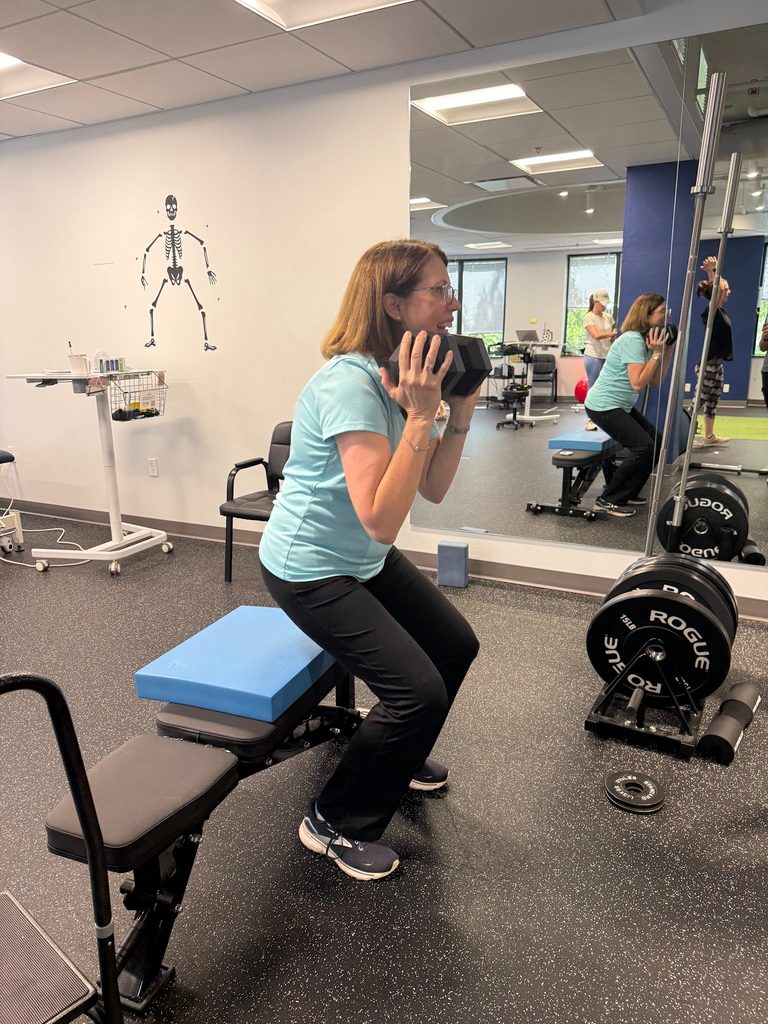
Squatting places a direct, controlled load through your hips and spine, which signals your body to reinforce the bone matrix exactly where fractures are most common. It is one of the most researched pieces of an effective osteoporosis workout, and the results are hard to ignore. For a deeper walkthrough of the mechanics, see Yes, You Should Be Able to Squat.
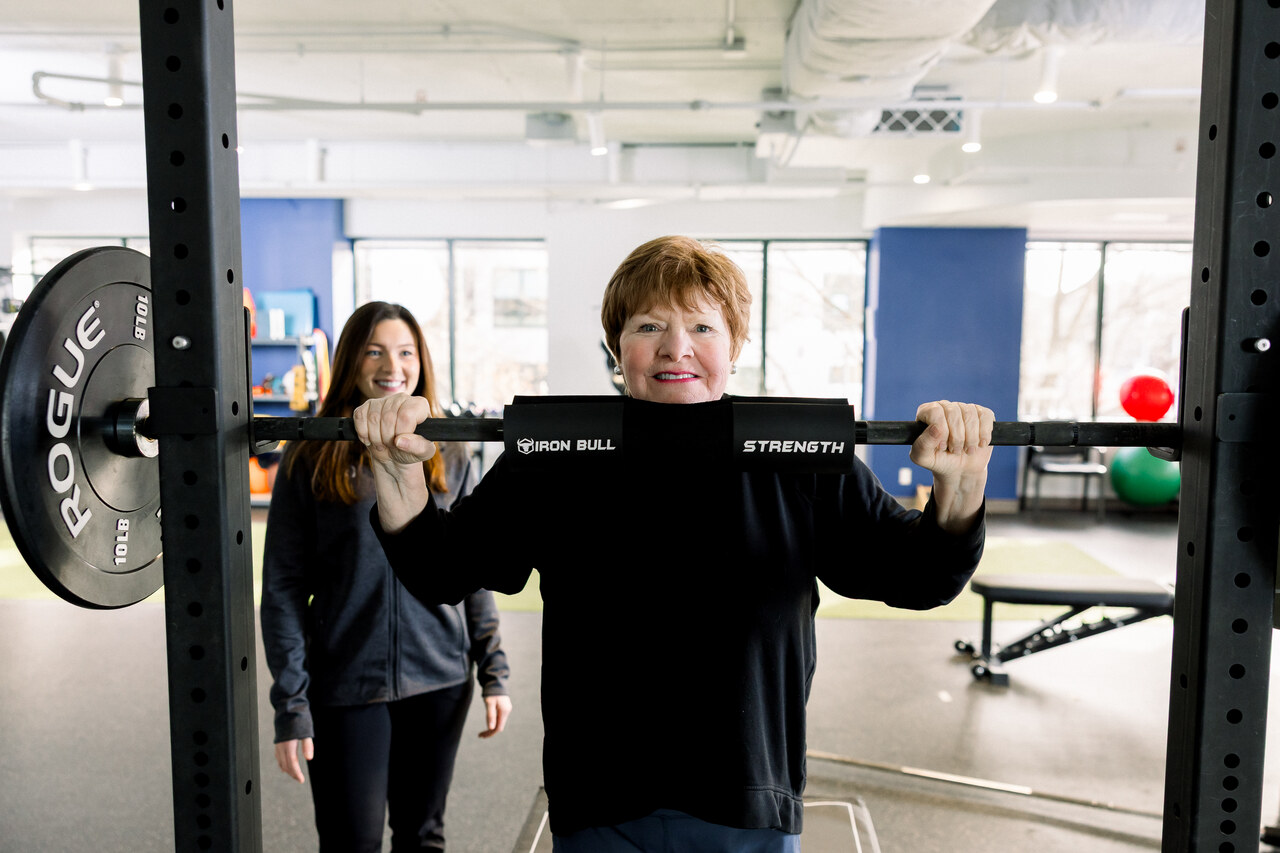
Start where you are. Sit-to-stands from a sturdy chair build the pattern with zero equipment. As strength and confidence grow, progress to a goblet squat, holding a weight close to your chest, and eventually to a loaded barbell squat if that fits your goals. Keep your chest up and your hips tracking back so your lower spine stays neutral throughout the movement.
The LIFTMOR trial supervised participants twice weekly for eight months at 80 to 85 percent of their one-rep max. Leg extensor strength increased more than 30 percent, and lumbar spine bone density rose nearly 3 percent, with an injury rate no higher than a gentler, low-intensity program. The follow-up MEDEX-OP trial, also published in the Journal of Bone and Mineral Research, reinforced that high-intensity resistance training improves hip bone strength in ways low-intensity training simply does not.
Our own clients describe the difference in plainer terms. One woman in our Bone Health Training Program told us, “Before I started, I could not lift anything very heavy, had balance issues, and weak back muscles. Since I started training, my back no longer hurts when getting out of bed or standing up, and I am able to lift landscaping rocks I could not lift before. I just feel better.“
If squatting heavier than you thought possible sounds appealing but a little intimidating, join our Bone Health Training Program waitlist and train it with a community of likeminded women and a licensed physical therapist watching every rep.
Safe Landings Add the Impact Your Bones Need
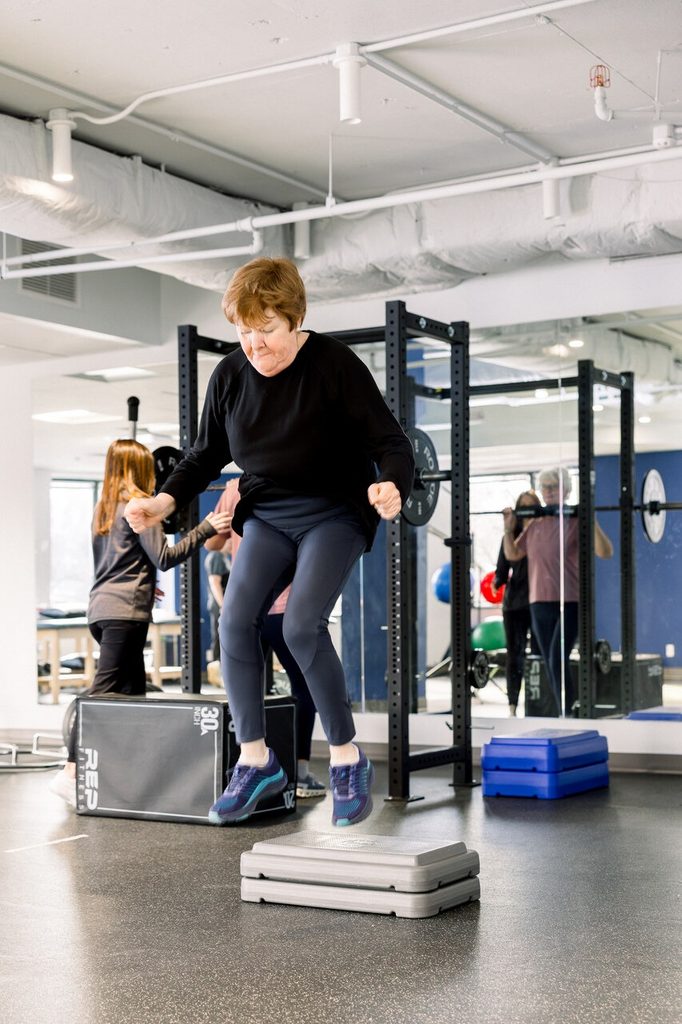
Bones need dynamic impact, not just steady load, to keep building. Landing from even a small jump sends a brief, controlled shockwave through your skeleton that tells osteoblasts, your bone-building cells, to get to work. Skipping impact altogether is one more way well-meaning caution can work against you. For more on why this matters beyond the gym, see Why Jumping Is Important for More Than Just Sports.
The key is a gradual build, never an aggressive one. A safe progression looks like this:
- Heel drops. Rise onto your tiptoes, then drop quickly onto your heels to introduce a small, controlled jolt.
- Low step-downs. Step off a curb-height surface and absorb the landing through bent knees and hips, not a stiff spine.
- Small broad jumps. Once step-downs feel easy, add short, low jumps on a soft, forgiving surface, aiming for a quiet landing every time.
Once you build up your progressions, we actually cue the ladies in our program to land with some impact. Instead of “landing softly” like we would tell other athletes, the impact helps to build bone density.
Frequently Asked Questions About Osteoporosis Workouts
Is it safe to squat if I have osteoporosis?
Yes, for most women, squatting is not just safe, it is one of the more protective things you can do for your spine and hips. Start with a chair-assisted sit-to-stand, build gradually, and work with a physical therapist if your bone density is significantly low or you have a history of vertebral fracture.
Can jumping actually build bone density?
Yes. Brief, controlled impact stimulates new bone growth in a way that low-impact activity like walking cannot match on its own. Progression matters far more than intensity, which is why supervised programs start with heel drops before ever introducing a jump.
What exercises should you avoid with osteoporosis?
Deep spinal flexion under load, like a weighted sit-up or touching your toes while holding something heavy, along with rapid twisting motions, carry the highest risk for people with lower bone density. On the other hand, squats, hip hinges, and well-progressed jumps are generally far safer than most people assume.
How much weight can you lift with osteoporosis?
There is no single number. The right load depends on your current strength and physical capacity. This is exactly why supervised assessment and progressive loading, rather than a generic weight limit, form the backbone of an effective osteoporosis workout.
How often should you workout to prevent or slow down osteoporosis?
Most research-backed programs, including LIFTMOR, use two supervised sessions per week over several months to see meaningful gains in bone density and strength.
Build Bones That Can Keep Up With Your Life
Building fracture-resistant bone is about combining targeted, heavy-enough loading with spine-sparing habits you use every day, whether you are in a gym or emptying a dishwasher. Both pieces work together to get you the full result.
Because bone density is delicate to work with, attempting high-intensity squats or jump progressions unsupervised at a typical gym carries real risk. A program built specifically around your DEXA scan, your history, and your goals looks completely different from a generic strength class, and that difference is what keeps you progressing instead of getting hurt.
And the best part is that you don’t have to do it alone. You get to do your osteoporosis workouts with a community of women in our Bone Health Training Program.
If you want the life-changing benefits of heavy squats and dynamic landings but would rather not figure out the progression alone, our licensed physical therapists supervise small groups at a 1-to-4 ratio, twice a week, adjusting every rep to your body. That is what an osteoporosis workout looks like when it is built right: heavy enough to matter, safe enough to trust.
Join the Bone Health Training Program waitlist for our upcoming Fairfax, Virginia cohort and take the next step toward stronger, more confident movement.

Leave a Reply